News detail
Global Anti‑Jamming GPS Market Expands Amid Rising Electronic Warfare Threats
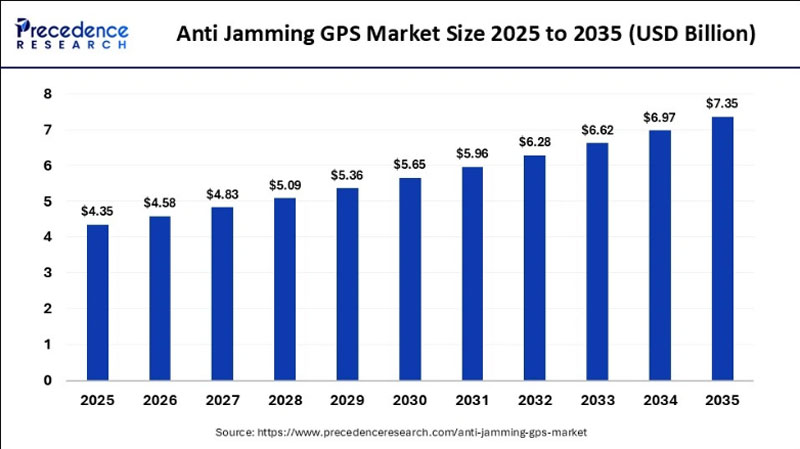
Global demand for anti‑jamming GPS solutions keeps surging as electronic‑warfare risks, regional geopolitical tensions, and fast‑growing autonomous applications reshape the satellite navigation industry. Latest market research shows the global anti‑jamming GPS market reached USD 4.35 billion in 2025, and will hit USD 4.58 billion in 2026. Projections indicate the market will grow to USD 7.35 billion by 2035, registering a 5.38% CAGR over 2026‑2035.
Anti‑jamming GPS systems defend GNSS receivers against intentional jamming and spoofing attacks. Leveraging CRPA controlled‑reception‑pattern antennas, beamforming, signal filtering and multi‑frequency satellite reception, these solutions work alongside inertial sensors to sustain stable positioning even when satellite signals are fully blocked. The technology serves defense, aviation, maritime, unmanned platforms and critical civilian infrastructure.
North America dominated the global market in 2025, backed by high defense spending and established industry players including Lockheed Martin, Raytheon Technologies and Northrop Grumman. The Asia‑Pacific region is forecast to deliver the fastest growth rate through the forecast window. Rising defense budgets, border security concerns, expanding autonomous‑vehicle deployment and investment in critical PNT infrastructure fuel market momentum across Asia, with China standing out as the region’s key market.
From a segmentation perspective, ground‑based platforms held the largest market share in 2025 for border security, logistics and precision‑agriculture use‑cases. Nevertheless, the airborne segment is set to achieve the highest CAGR, driven by broad adoption across military aircraft, UAVs and autonomous aerial systems operating in GPS‑denied environments.

Military‑grade GPS remained the leading technology segment in 2025 due to battlefield navigation, targeting and mission‑planning requirements. Meanwhile, software‑based anti‑jamming technology will record the strongest growth. Cost‑effective and highly adaptive software algorithms detect and suppress radio interference, attracting growing interest from both defense and commercial operators.
Military and defense applications captured the majority market share in 2025. Missile guidance, warship navigation, fighter jets and drone operations heavily rely on assured positioning. Notably, the civilian and commercial segment is emerging as a high‑growth area. Shipping, commercial aviation, autonomous vehicles and telecom infrastructure increasingly require robust anti‑interference navigation capacity. Government agencies represented the top end‑user group in 2025, while military forces are expected to post the fastest CAGR in coming years.
Artificial intelligence brings transformative upgrades for anti‑jamming GPS hardware. AI algorithms analyse complex RF environments in real‑time, identify jamming and spoofing signals, and optimise CRPA antenna beam‑nulling performance. Running locally on receiver embedded systems instead of cloud networks, AI‑powered navigation delivers instant interference response for mission‑critical platforms. SandboxAQ rolled out an AI‑enabled anti‑spoofing navigation system back in June 2024, marking a major milestone for the sector.

Key industry trends include strategic partnerships between defense contractors and aircraft OEMs, continuous hardware and software innovation, rising worldwide defence expenditure, plus strong market demand for miniaturised, lightweight anti‑jamming units suitable for UAVs and portable defence equipment. Multiple vendors launched next‑generation GNSS anti‑jamming antennas and software navigation platforms throughout 2025 to enhance navigation resilience under complex electromagnetic conditions.
The industry follows mainly B2B and B2G sales channels through defence contracts and specialised system integrators, rather than open retail markets. Leading market participants include Northrop Grumman, Raytheon Technologies, Lockheed Martin, Boeing, L3Harris Technologies, General Dynamics, Elbit Systems and Thales Group.
As GPS jamming and spoofing incidents multiply worldwide, resilient assured‑PNT solutions will stay a core investment priority for governments and commercial enterprises over the next decade.
Creative Ideas
Are we in agreeance cross functi
onal teams enable out
Super Safety
Are we in agreeance cross functi
onal teams enable out
In Time Delivery
Are we in agreeance cross functi
onal teams enable out
24/7 Support
Are we in agreeance cross functi
onal teams enable out

Get Price
Please Leave your message you want to know! We will respond to your inquiry within 24 hours!